


God The Invisible King
Publisher: Cassell and Company
Format: Hardback
ISBN: none
When most people think of H. G. Wells, they picture time machines, invisible men, Martian invasions and humanity being menaced by giant tripods. God the Invisible King comes as a surprise because Wells decided, at least for one book, that conquering space and time was not ambitious enough. Instead, he turned his attention to the considerably larger question of God.
Published in 1917, in the shadow of the First World War, this remarkable volume finds one of the twentieth century’s most famous writers wrestling with faith, morality, civilisation and the future of humanity. The result is neither conventional theology nor straightforward philosophy. It is very much an H. G. Wells book, meaning that even when discussing religion he approaches the subject with the confidence of a man perfectly willing to redesign the entire universe if he felt improvements were required.
Wells presents a vision of God that differs from many traditional religious ideas of his time. Rather than focusing on established doctrine, he develops his own concept of an active, evolving spiritual force working through human beings and society. Whether readers agree with him or not, there is never any doubt that Wells is thinking on a grand scale.
There is a wonderful irony in the book’s existence. Here is the author who became famous for imagining journeys through time and invasions from Mars sitting down to write about spiritual belief. Yet in many ways it makes perfect sense. Wells was always interested in humanity’s future, and God the Invisible King represents his attempt to understand what moral and spiritual foundations that future might require.
The book also serves as a fascinating historical document. Written during one of the most turbulent periods in modern history, it reflects the anxieties, hopes and uncertainties of an age struggling to make sense of war and social upheaval. Wells was not content merely to observe these events. He wanted to understand what they meant.
Modern readers may find themselves repeatedly amused by the sheer boldness of the undertaking. Many writers cautiously explore a subject. Wells marches directly into it carrying enough ideas to fill several books. One gets the impression that if given sufficient time he would happily have rewritten philosophy, religion and political theory before breakfast.
Yet beneath the intellectual confidence lies a sincere search for meaning. The book reveals a writer grappling with questions that remain relevant more than a century later: how should people live, what gives life purpose and what role might belief play in shaping society?
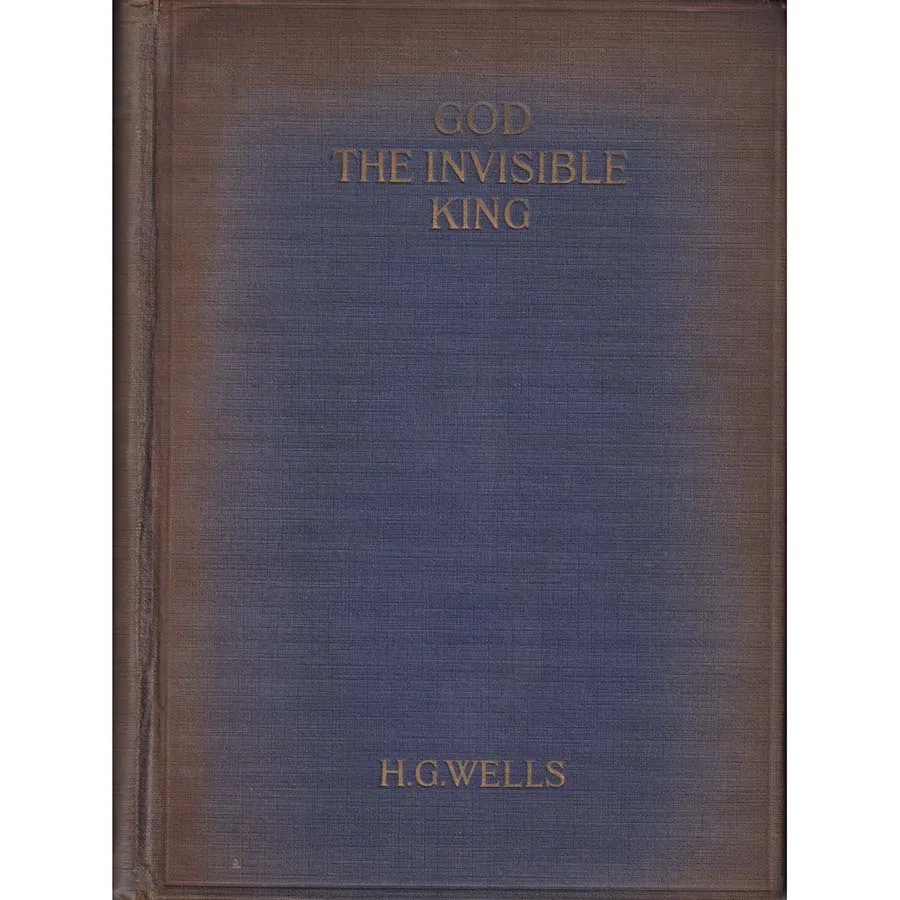
This 1917 Cassell and Company edition remains in good condition and comes from the shelves of Crappy Old Books. The front cover shows some fading from age and exposure, while the upper edge of the rear board has a noticeable notch missing. Neither defect affects readability, and both simply contribute to the character of a volume that has already travelled through more than a century of history.
An excellent acquisition for collectors of H. G. Wells, religious philosophy, early twentieth-century thought or unusual non-fiction. It offers a chance to encounter Wells not as the prophet of science fiction, but as a thinker attempting to answer some of the biggest questions imaginable. The Martians can wait. This time, Wells is trying to explain God.
Keep browsing: See more Religion books Other books by HG Wells
